Stories →
Gates Ventures (BGC3)
Content Design
Can you rewrite 13.8 billion years of history?
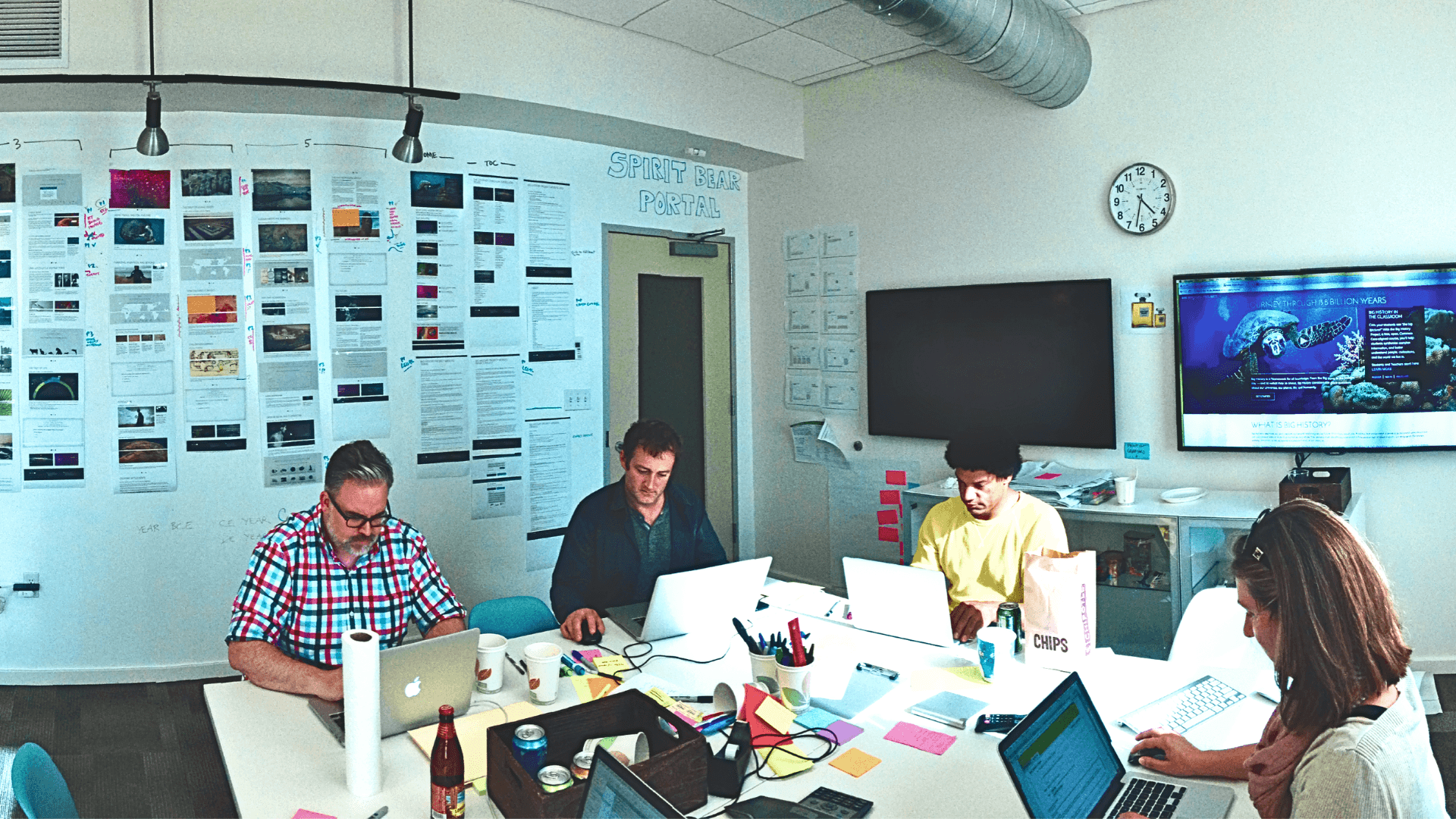
We need it in five chapters. You have eight weeks.
This was Gates Ventures (previously BGC3) calling. Bill Gates wanted to revolutionize how kids learn history; not just human history, but everything history. From the Big Bang to your birthday. One continuous story. The existing Big History Project was ambitious. It was also failing. Kids were dropping like flies. 65% never made it past the first module. Teachers were drowning in content. The platform felt like trying to drink from a fire hose while someone explained quantum physics.
We had to make the incomprehensible comprehensible. No pressure.
The real problem we had to say out loud
Here's what we discovered after a walk though with the client and summarizing their surveys of 200+ students: The content wasn't too hard. It was too disconnected.
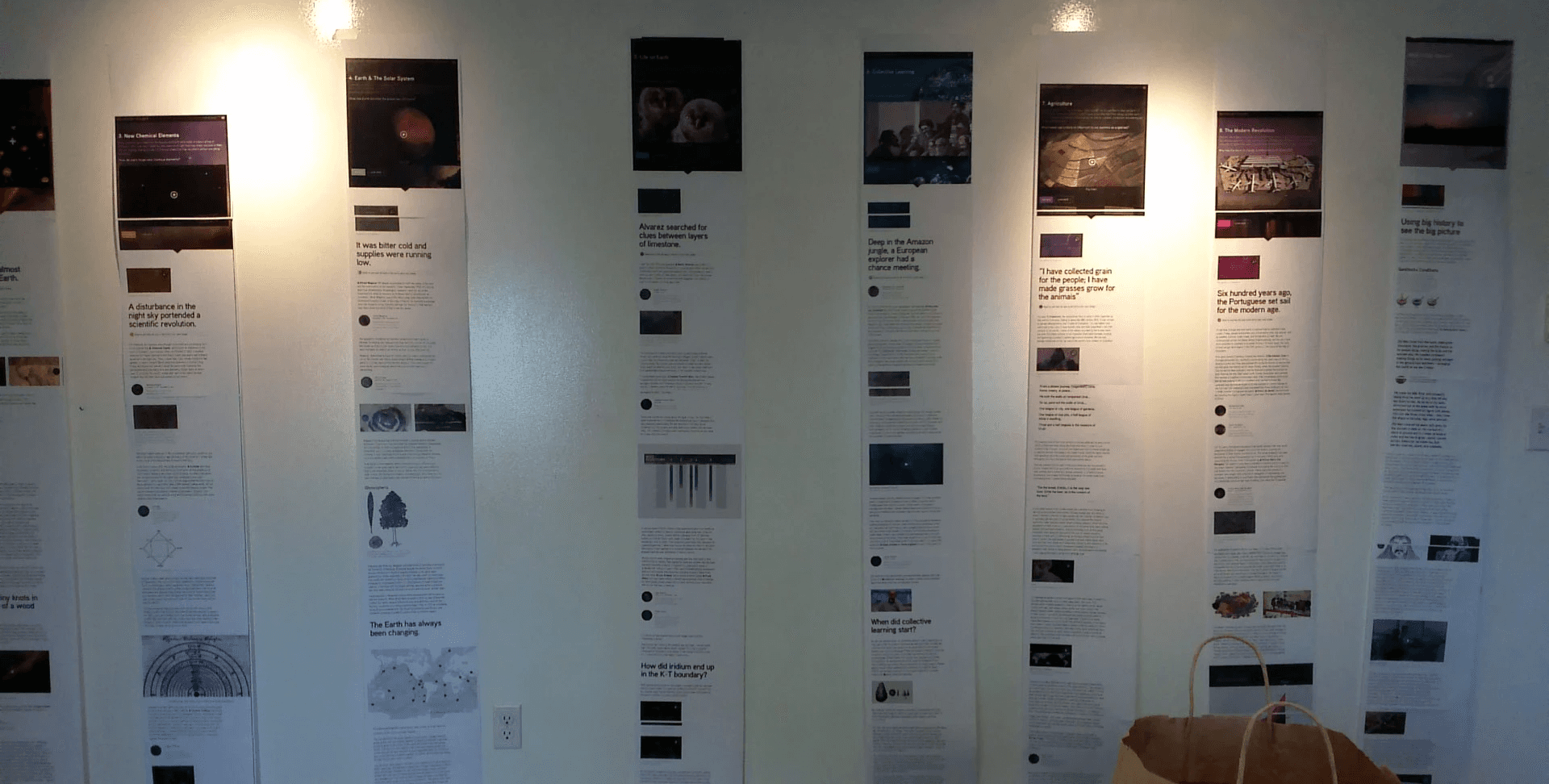
Kids would learn about the Big Bang on Monday, ancient Rome on Wednesday, and climate change on Friday. Nothing linked together. It was like watching a movie where every scene was from a different film.
Teachers told us they loved the concept but couldn't figure out how to teach it. One teacher in Texas put it perfectly: "I'm supposed to cover 13.8 billion years in a semester. My textbook stops at the Cold War."
Building a universe (in order, this time)
We threw out the traditional approach and leaned on what was working: Threshold Concepts.
Eight major moments when the universe got more complex:
Threshold | What Happened | Why Kids Should Care |
|---|---|---|
1. Big Bang | Universe begins | Everything starts here, including you |
2. Stars | First stars form | Your atoms were made in stars |
3. New Elements | Chemistry gets interesting | Building blocks for everything |
4. Earth | Our planet forms | Home sweet home |
5. Life | Biology enters the chat | Things get weird and wonderful |
6. Collective Learning | Humans share knowledge | What makes us different |
7. Agriculture | We settle down | Civilization begins |
8. Modern Revolution | Everything accelerates | Welcome to now, what’s next? |
Each threshold built on the last. Finally, a story that actually made sense.
We need it in five chapters. You have eight weeks.
This was Gates Ventures (previously BGC3) calling. Bill Gates wanted to revolutionize how kids learn history; not just human history, but everything history. From the Big Bang to your birthday. One continuous story. The existing Big History Project was ambitious. It was also failing. Kids were dropping like flies. 65% never made it past the first module. Teachers were drowning in content. The platform felt like trying to drink from a fire hose while someone explained quantum physics.
We had to make the incomprehensible comprehensible. No pressure.
The real problem we had to say out loud
Here's what we discovered after a walk though with the client and summarizing their surveys of 200+ students: The content wasn't too hard. It was too disconnected.
Kids would learn about the Big Bang on Monday, ancient Rome on Wednesday, and climate change on Friday. Nothing linked together. It was like watching a movie where every scene was from a different film.
Teachers told us they loved the concept but couldn't figure out how to teach it. One teacher in Texas put it perfectly: "I'm supposed to cover 13.8 billion years in a semester. My textbook stops at the Cold War."
Building a universe (in order, this time)
We threw out the traditional approach and leaned on what was working: Threshold Concepts.
Eight major moments when the universe got more complex:
Threshold | What Happened | Why Kids Should Care |
|---|---|---|
1. Big Bang | Universe begins | Everything starts here, including you |
2. Stars | First stars form | Your atoms were made in stars |
3. New Elements | Chemistry gets interesting | Building blocks for everything |
4. Earth | Our planet forms | Home sweet home |
5. Life | Biology enters the chat | Things get weird and wonderful |
6. Collective Learning | Humans share knowledge | What makes us different |
7. Agriculture | We settle down | Civilization begins |
8. Modern Revolution | Everything accelerates | Welcome to now, what’s next? |
Each threshold built on the last. Finally, a story that actually made sense.
The secret sauce: multiple paths, one destination
Not everyone learns the same way. Shocking, right? We created four parallel paths through the same content:
For Visual Learners | For Readers | For Hands-On Learners | For Social Learners |
|---|---|---|---|
Interactive timelines they could zoom through. Imagine Google Earth, but for time. | Deep-dive articles with "choose your own adventure" style exploration. | Simulations where they could create stars, evolve species, build civilizations. | Collaborative projects where classes could build their own Big History. |
The microcopy that mattered
This is where content design gets fun. We rewrote basically everything. Some favorites:
❌ Old | 🌟 New |
|---|---|
"The accretion of matter in the early solar system led to planetary formation" | "Dust + gravity + time = planets (including ours)" |
"Assessment Module 3: Stellar Nucleosynthesis" | "Quiz: How Stars Cook Up Elements" |
"Error: Invalid submission" | "Hmm, that didn't work. Try again…even the universe needed a few attempts to get things right" |
Every word mattered. We weren't just teaching history; we were telling a story.
The secret sauce: multiple paths, one destination
Not everyone learns the same way. Shocking, right? We created four parallel paths through the same content:
For Visual Learners | For Readers | For Hands-On Learners | For Social Learners |
|---|---|---|---|
Interactive timelines they could zoom through. Imagine Google Earth, but for time. | Deep-dive articles with "choose your own adventure" style exploration. | Simulations where they could create stars, evolve species, build civilizations. | Collaborative projects where classes could build their own Big History. |
The microcopy that mattered
This is where content design gets fun. We rewrote basically everything. Some favorites:
❌ Old | 🌟 New |
|---|---|
"The accretion of matter in the early solar system led to planetary formation" | "Dust + gravity + time = planets (including ours)" |
"Assessment Module 3: Stellar Nucleosynthesis" | "Quiz: How Stars Cook Up Elements" |
"Error: Invalid submission" | "Hmm, that didn't work. Try again…even the universe needed a few attempts to get things right" |
Every word mattered. We weren't just teaching history; we were telling a story.
More than numbers, the feedback mattered most:
"My daughter asked me where atoms come from. Thanks to Big History, I actually knew the answer."
"For the first time, history makes sense as ONE story, not a million random facts."
Where we got lucky
Three months after launch, a student in Seattle used our platform to create a presentation about climate change that went viral. Her argument: "If the universe took 13.8 billion years to create us, maybe we should take better care of it."
That wasn't in our success metrics. But it might have been the biggest win of all.
What I learned about learning
Complexity needs clarity, not simplification. We didn't dumb down quantum physics (because nobody actually gets it). We made it navigable.
Stories beat facts every time. Kids remember narratives, not data points.
Teachers are designers too. Give them tools, not prescriptions.
Yes, we spent a week debating whether "lifelong" is hyphenated. (It's not.) These details add up to credibility.
Ripple effects
Today, Big History is in 1,500+ schools globally. It's been translated into 12 languages. Over 500,000 students have learned that their story started with a bang…literally.
But here's what I'm most proud of: Teachers tell us their students see connections everywhere now. Science class connects to history. History connects to English. Everything connects to everything.
That's what education should be; not subjects in silos, but understanding how it all fits together.
Because once you see the big picture, you can't unsee it.
The technical bits
Platform: Responsive web application
Scale: 500,000+ active users
Localization: 12 languages
Accessibility: WCAG 2.1 AA compliant
More than numbers, the feedback mattered most:
"My daughter asked me where atoms come from. Thanks to Big History, I actually knew the answer."
"For the first time, history makes sense as ONE story, not a million random facts."
Where we got lucky
Three months after launch, a student in Seattle used our platform to create a presentation about climate change that went viral. Her argument: "If the universe took 13.8 billion years to create us, maybe we should take better care of it."
That wasn't in our success metrics. But it might have been the biggest win of all.
What I learned about learning
Complexity needs clarity, not simplification. We didn't dumb down quantum physics (because nobody actually gets it). We made it navigable.
Stories beat facts every time. Kids remember narratives, not data points.
Teachers are designers too. Give them tools, not prescriptions.
Yes, we spent a week debating whether "lifelong" is hyphenated. (It's not.) These details add up to credibility.
Ripple effects
Today, Big History is in 1,500+ schools globally. It's been translated into 12 languages. Over 500,000 students have learned that their story started with a bang…literally.
But here's what I'm most proud of: Teachers tell us their students see connections everywhere now. Science class connects to history. History connects to English. Everything connects to everything.
That's what education should be; not subjects in silos, but understanding how it all fits together.
Because once you see the big picture, you can't unsee it.
The technical bits
Platform: Responsive web application
Scale: 500,000+ active users
Localization: 12 languages
Accessibility: WCAG 2.1 AA compliant
Read more stories:

Building tomorrow's intelligence on yesterday's mess
How we turned 20 years of financial services content into an AI-ready foundation

Toyota dealer training transformation
How we brought car dealerships into the digital age and killed the three-ring binder
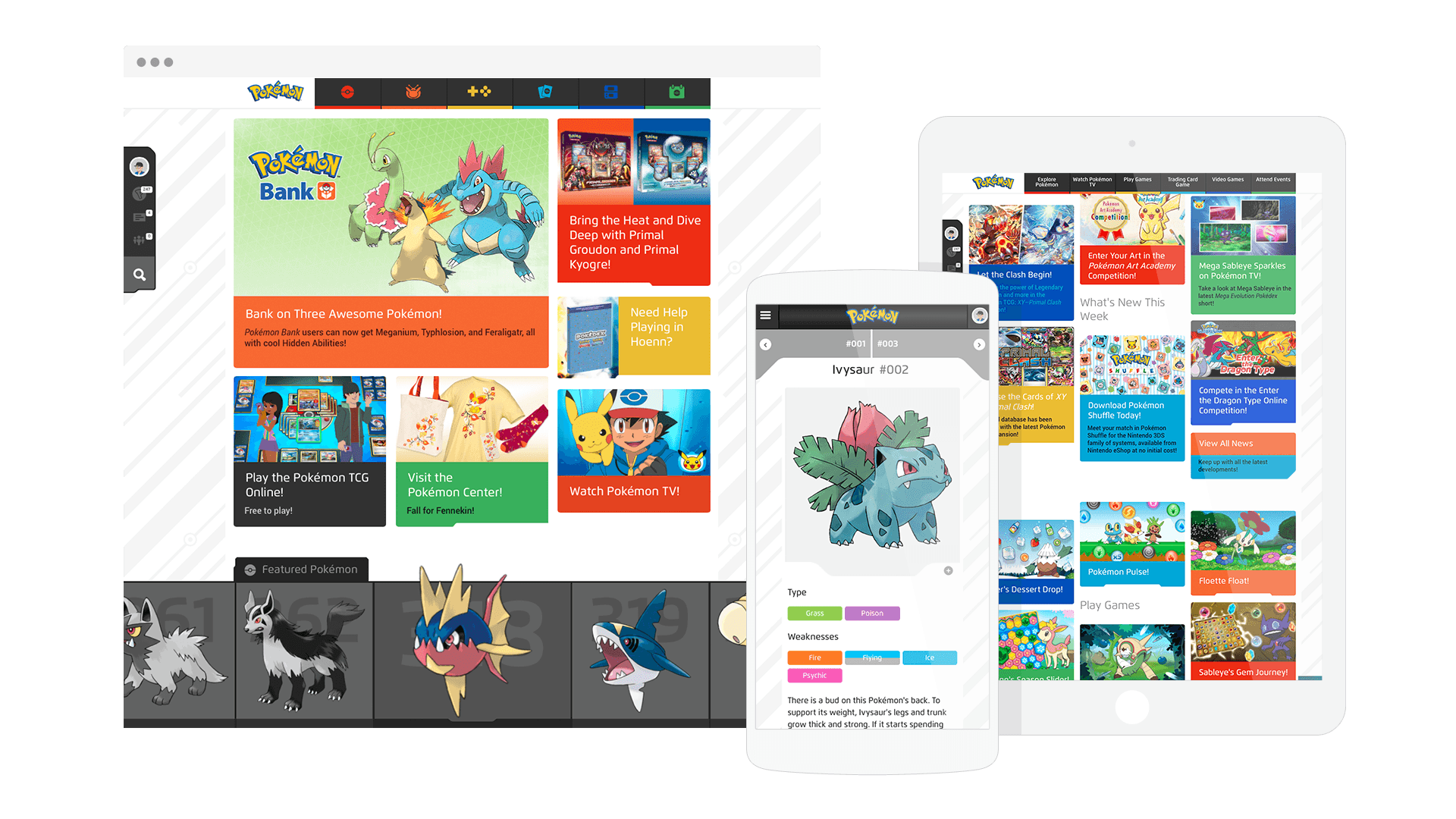
Gotta Serve 'Em All: Redesigning Pokémon.com
Building a digital home for kids, parents, and 30-something collectors